
Owning the
middle market


As RSM sharpened its ambition to become the first-choice advisor to the middle market, the firm recognized that technical capability alone was not enough. It needed to know this segment more deeply than any competitor—and turn that knowledge into differentiated insight.
“We determined that to own the middle market, we had to have more knowledge and insights about the middle market than anyone else.”
When Webber Laczo shared that perspective with then Managing Partner & CEO Joe Adams, he said: “Why don’t you go figure out how to do that?”
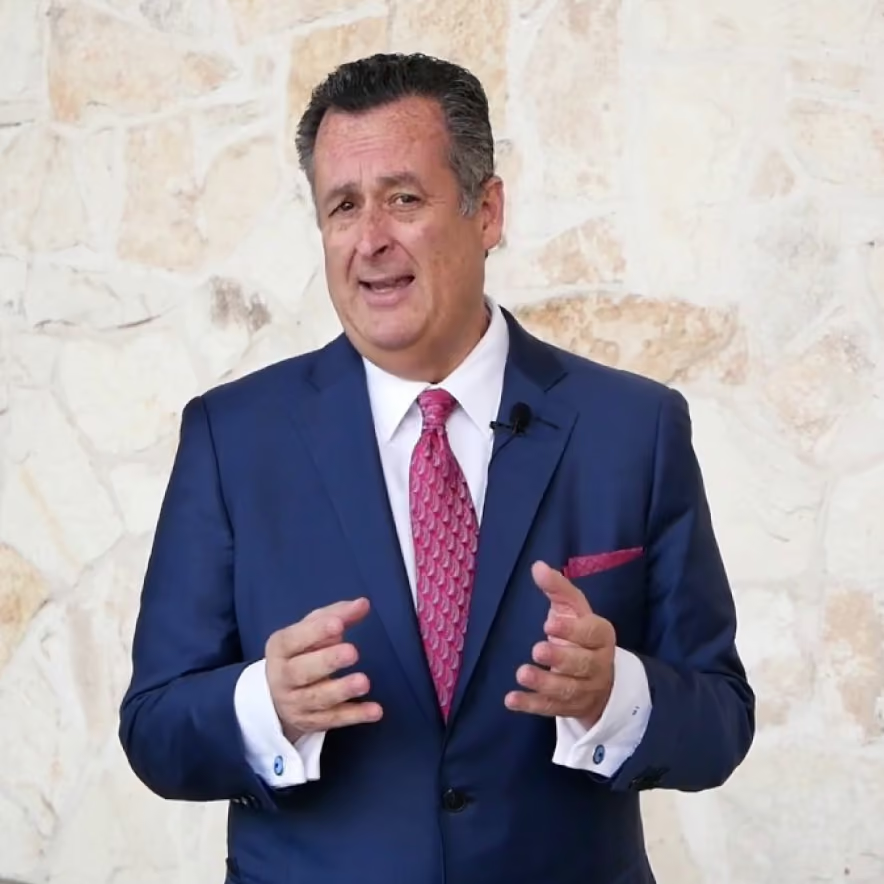
The firm had gotten to know Joe Brusuelas, a senior economist who had become deeply interested in the middle market—what he called “the real economy”—after the global financial crisis of 2007−09, as he saw the decoupling of the real economy and the financial economy. RSM brought Brusuelas onboard in 2014 and a thought leadership platform began to take shape.
The firm then selected a research vendor to help develop proprietary insights. In 2015, it launched The Real Economy—a publication focused on trends and issues relevant to middle market businesses—and began collecting data for what would become the firm’s signature research product. In 2016, the RSM US Middle Market Business Index launched. Built in collaboration with The Harris Poll and Moody’s Analytics, the MMBI is based on a proprietary panel of middle market business leaders and measures sentiment, performance and outlook on a quarterly basis.
The index gave RSM something no competitor had: a forward-looking, data-driven view of how the middle market was performing. Clients began using it to benchmark their own prospects against how leaders of businesses like theirs were thinking about the future.
More than a decade of consistent investment established RSM as the definitive middle market thought leader with economic insights and industry expertise now a core part of the firm's identity.
In 2026, RSM took another step: formally redefining the middle market as businesses generating between $30 million and $10 billion in revenue—broadening the scope to reflect how this segment had grown in scale and sophistication.
“Relying on definitions based on decades-old economic data means misreading the most dynamic force in the U.S. economy. Today’s middle market companies operate at greater scale, with higher fixed costs and far more exposure to global volatility.”
Understanding the middle market was never just an academic exercise. It was a competitive strategy—and it worked.