
Becoming a
national firm



In 1997, McGladrey & Pullen’s board appointed a three-person office of the managing partner and formed a strategic advisory group to study stalled growth and profitability. Over two years, the seven-partner group considered 18 possible paths—from going public to merging with a Big Four firm—and ultimately chose a national strategy that would shape one of the firm’s most dynamic periods.
“What we were learning was that not every region in the country was the same, not every office was at the same place of maturity and not every one of our markets were penetrated in the same way,” recalls Bob Jensen, who served with Mark Scally and Tom Rotherham in the office of the managing partner. That realization helped shape a more intentional long-term strategy.
“The decision was to become a national firm,” says Doug Opheim, who also served in the strategic advisory group. To become truly national, leaders believed they needed to embrace the space between the Big Four and the smaller “large locals” and build toward becoming the premier service provider for the middle market. “And in order to do that,” Opheim continues, “we needed capital.”
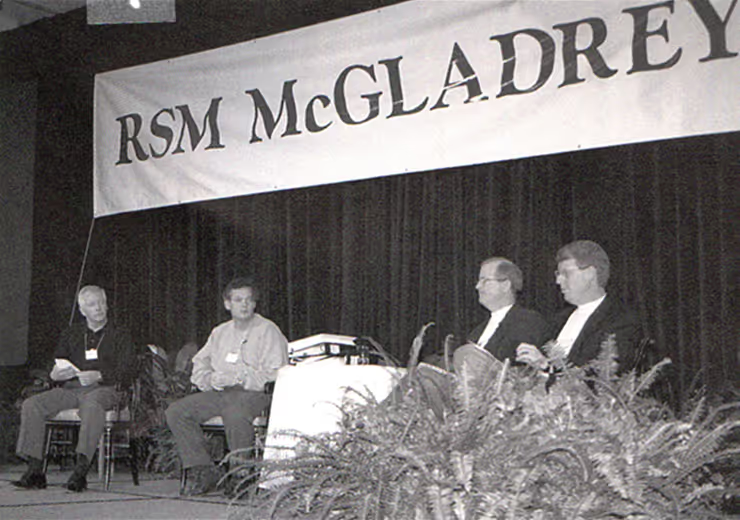
That infusion of capital came through the 1999 sale of the firm’s consulting and tax practices to H&R Block, which adopted the name RSM McGladrey, while McGladrey & Pullen retained the assurance business. The transaction gave the organization the financial capacity to pursue a national growth strategy more aggressively by expanding into major metropolitan markets, broadening capabilities and moving beyond its historic regional footprint.
The proceeds helped fund an extraordinary run of mergers from 1999 to the mid-2000s, giving the firm the means to move quickly as the profession consolidated and competitors pursued their own roll-up strategies in the middle market.

That opportunity increased when American Express decided to exit the CPA firm business. The acquisition of the American Express Tax & Business Services division vaulted the firm into the $1 billion tier—once largely the province of the Big Four—and established stronger positions in major markets, including Chicago, New York, Baltimore and Cleveland. It was a defining moment in the firm’s evolution from a strong regional player into a truly national organization.
Despite the firm’s rapid growth in scale and reach, the culture and core values Ira B. McGladrey established remained intact. The firm generally sought strategic combinations where values, client focus and service philosophy aligned naturally; where they did not, leaders emphasized disciplined integration to bring people, processes and expectations together.
Kate Seitz, assurance partner and member of the RSM US Board of Directors, recalls the people-centered approach to integration in Chicago following the American Express Tax & Business Services acquisition.
“Even before the (Amex) merger became official, we got together socially to get to know each other. They would solicit our input on how the integration was going, and they quickly made me feel like we would have a great culture together.”
These transactions also expanded the firm’s services and geographic reach. Specialized capabilities—including technology risk management, international tax, state and local tax advisory, and more—came through acquisitions in the 2000s.
During this time, the firm also built a sales organization. Rod Reimann joined RSM in 2004 to lead the function, and 10 specialists from around the country soon followed. "Until our arrival, virtually all of the growth came from the partners themselves. They were expected to grow the business in addition to fulfilling their service to clients," says Reimann. "From a culture standpoint, [the sales function] was very different for the firm. It was exciting, it was challenging and it was truly the launchpad for what is now a 320-person North American sales organization."

Former Managing Partner Joe Adams says the H&R Block relationship was instrumental in RSM’s expansion: “H&R Block did absolutely everything they said they were going to do, and they really helped us to create a national firm. We were able to form offices in 22 of the top 25 metropolitan markets and get access to more talent. We were able to grow our consulting business.” His reflection underscores that this era was not just about getting bigger; it was about building the capabilities, market access and confidence required to operate as a national firm.